Trotter Galleries, Inc.
  • Home
  • About Us
  • Pacific Grove Museum-Gallery
  • Mora ‘Fable’ Murals
  • Inventory
    • New Acquisitions
    • Early California
    • American
    • Woodblocks, Etchings, Pastels and Prints
    • Sold Inventory
    • Sell Your Art
    • Art Search
  • Exhibitions
  • Contact Us
Menu
  • Home
  • About Us
  • Pacific Grove Museum-Gallery
  • Mora ‘Fable’ Murals
  • Inventory
    • New Acquisitions
    • Early California
    • American
    • Woodblocks, Etchings, Pastels and Prints
    • Sold Inventory
    • Sell Your Art
    • Art Search
  • Exhibitions
  • Contact Us
Carmel
831.625.3246
Pacific Grove
831.649.3246
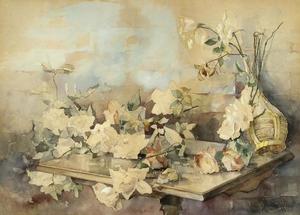
Franz A. Bischoff - "Still-Life with Roses" - Watercolor - 22 1/4" x 30 3/4" - Signed and dated 1890 lower right
<br>Framed by Richard Tobey Fine Frames, Los Angeles, California
<br>
<br>
<br>As a china painter, Bischoff was most famous for his roses, and became known as the "King of the Rose Painters". This watercolor was painted the year that he and Bertha Greenwald were married in Fostoria, Ohio.
Franz A. Bischoff
"Still-Life with Roses"
1890

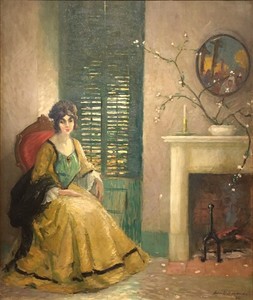
Lester Boronda - "Adobe Interior" - Monterey - Oil on canvas - 36" x 30" - Signed and monogramed lower right
<br>
<br>Exhibited: National Academy of Design, NY; Art Institute of Chicago; Corcoran Gallery, Washington, D.C.; Pennsylvania Academy of Fine Art; 
<br>prestigious Braus Gallery in New York in 1914 with a successful one-man exhibit of his Spanish California paintings.
<br>
<br>Illustrated in Art in California, 1916, Plate No. 78. (This book was written as a tribute to the successful artists of the day illustrating artworks which were exhibited at the P.P.I.E./1915; however, deciding to also include "Adobe Interior" by Boronda, a significant tribute paid to him by fellow artists who were exhibitors).
<br>
<br>Although born in Reno, NV on July 24, 1886, Boronda was a member of an early California family (his great-grandfather was a member of the second Junipero Serra expedition into Alta California in 1770). He was raised on a Salinas cattle ranch where today the family home is a state historical landmark.
<br>
<br>His art studies began in San Francisco at the Mark Hopkins Institute under Arthur Mathews and continued at the ASL in NYC under Frank Vincent DuMond. The finishing touches to his art training were under Jean Paul Laurens in Paris and in Munich. 
<br>
<br>Leaving California in 1913, he moved to New York where he established an important craftsman center which specialized in wrought iron. His painting specialty in California had been genre of old Monterey and, after moving to the East, he painted street scenes of New York. Boronda often spent summers in Mystic, CT before his death in New Canaan on Sept. 19, 1953. 
<br>
<br>	Member: Carmel Art Association; Mystic Art Association
<br>	Exhibited: Del Monte Art Gallery (Monterey), 1910; NAD; AIC; Carnegie Institute, 1912; CGA, 1914-1923; PAFA, 1924.
<br>	In: Monterey Peninsula Museum of Art; Salinas City Council; Nevada Museum (Reno); California Historical Society; PAFA; Rochester (NY) Mechanics Institute.
<br>
<br>
<br>Casa Boronda (built by Don José Manuel Boronda around 1817) is the oldest standing private residence in Monterey and the very first to be constructed outside the protective walls of the Old Presidio.<br>• Address: 100 Boronda Lane, Monterey, CA 93940<br>• Location Details: It sits on a hidden four-acre mesa in the Alta Mesa neighborhood, just up the hill and a short walk from historic downtown Monterey and the San Carlos Cathedral
Lester Boronda
"Adobe Interior" - Monterey
c. 1913

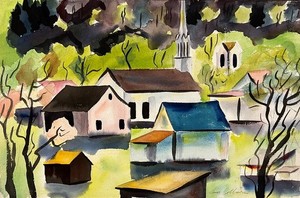
Samuel  Bolton Colburn - "Country Church" - Watercolor - 13 3/4" x 21 1/2" - Signed lower right
<br>Double-sided: Abandoned Mining Town
Samuel Bolton Colburn
"Country Church"
c. 1938

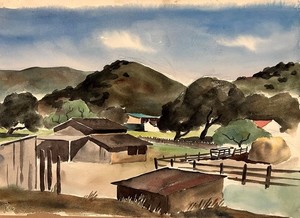
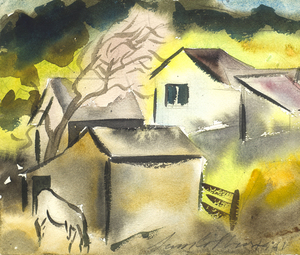
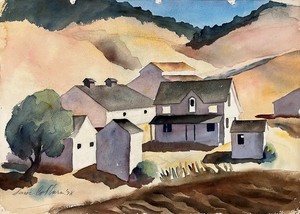
Samuel  Bolton Colburn - "Farm Houses" - Watercolor - 13" x 19" - Signed and dated lower left
Samuel Bolton Colburn
"Farm Houses"
1938

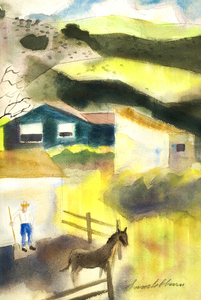
Samuel  Bolton Colburn - "Farmer with Horse" - Watercolor - 21" x 14" - Signed lower right
<br>Double-sided: Pheiffer's Beach - 1955
<br>Signed and dated lower right
Samuel Bolton Colburn
"Farmer with Horse"
c. 1940

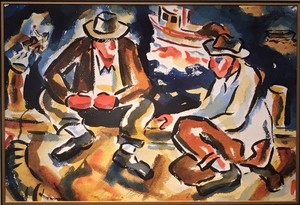
Samuel  Bolton Colburn - "Fishermen 'Confab' on the Wharf" - Oil on canvas - 12" x 16" - Signed and dated lower right
<br>
<br>Although known for his watercolors, pastels and charcoals, he excelled in oil - a rarely painted medium by the artist.
Samuel Bolton Colburn
"Fishermen 'Confab' on the Wharf"
1940

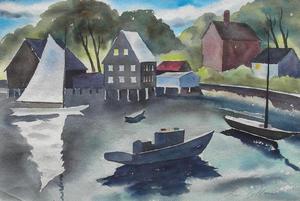
East coast scene in watercolor depicting four small boats in the harbor; with five structures of various sizes on stilts; with two houses in the near distance in a grove of trees.
Samuel Bolton Colburn
"Grey Boats"
c. 1942

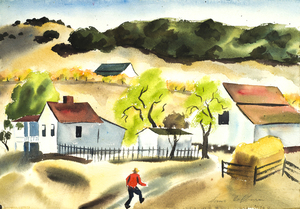
Samuel  Bolton Colburn - "Happy Farmer" - Watercolor - 14" x 20" - Signed lower right
<br>
<br>
<br>
<br>Reproduced in OLLI@CSUMB/Fall Catalogue-2022, page 22.
Samuel Bolton Colburn
"Happy Farmer"
1940

Samuel  Bolton Colburn - "Hatton Ranch" - Carmel Valley - Oil on masonite - 16" x 43 1/2" - Signed lower right
<br>
<br>A masterwork of one of Colburn's early and rare oil paintings both in composition and color, and of exceptional size.
<br>
<br>This really is an outstanding painting by Colburn, great color and paint application, and the largest work in oil we’ve seen.
Samuel Bolton Colburn
"Hatton Ranch" - Carmel Valley
c. 1949

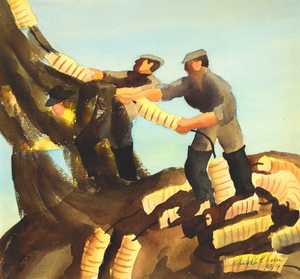
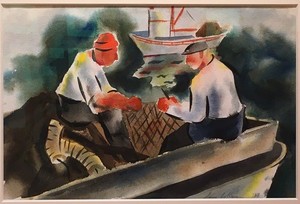
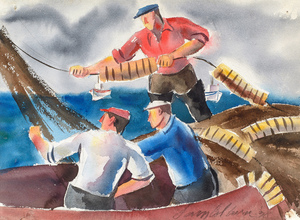
Samuel  Bolton Colburn - "Hauling the Nets" - Watercolor - 12 1/2" x 13 1/4" - Signed and dated lower right
<br>
<br>Reproduced in OLLI@CSUMB/Fall Catalogue-2022, page 11.
Samuel Bolton Colburn
"Hauling the Nets"
1939

Samuel  Bolton Colburn - "Hillside Farm with Water Tank" - Watercolor - 20 1/2" x 14" - Signed lower left
<br>Double-sided: Cacti - 1944 
<br>Signed and dated lower left
<br>
<br>
<br>Reproduced in OLLI@CSUMB/Fall Catalogue-2022, FRONT COVER
Samuel Bolton Colburn
"Hillside Farm with Water Tank"
c. 1940

Samuel  Bolton Colburn - "Hillside Houses" - Watercolor - 10 1/2" x 16 1/4" - Signed and dated lower right
<br>Double-sided: Rocks and Water (unsigned)
<br>
<br>
<br>Reproduced in OLLI@CSUMB/Fall Catalogue-2022, page 16.
Samuel Bolton Colburn
"Hillside Houses"
1942

Samuel  Bolton Colburn - "Horse at the Ranch" - Watercolor - 8" x 9 1/2" - Signed and dated lower right
<br>
<br>
<br>Reproduced in OLLI@CSUMB/Fall Catalogue-2022, page 13.
Samuel Bolton Colburn
"Horse at the Ranch"
1941

A large vat dominates this watercolor - on the wharf in Monterey - five fishermen are hard at work filling the vat with the nets used to catch the fish.
Samuel Bolton Colburn
"In the Vat" - Monterey
c.1940

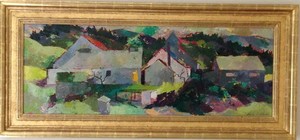
Samuel  Bolton Colburn - "Lonesome House" - Watercolor - 15" x 21" - Signed and dated lower right
Samuel Bolton Colburn
"Lonesome House"
1937

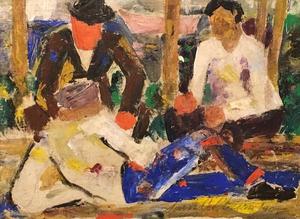
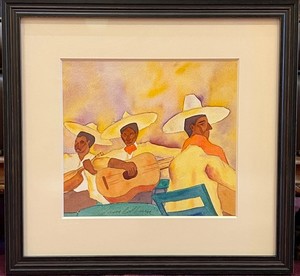
Samuel  Bolton Colburn - "Mexican Street Singers" - Watercolor - 10 1/2" x 11 1/2" - Signed and dated lower left
<br>
<br>Reproduced in OLLI@CSUMB/Spring Catalogue-2019, page 30.
Samuel Bolton Colburn
"Mexican Street Singers"
1939

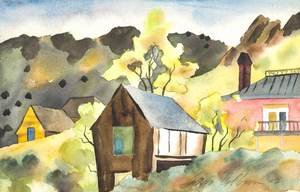
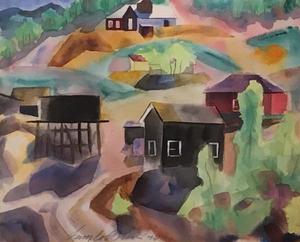
A landscape scene with colorful mountains and also with several miners cabins.
Samuel Bolton Colburn
"Mining Town"
1942

Samuel  Bolton Colburn - "Net Menders" - Monterey Bay - Watercolor - 13 1/2" x 21" - Signed and dated lower right
<br>Double sided: Sea and Land
<br>
<br>Sam Colburn gained his substantial reputation as a watercolorist and for his early paintings of the Monterey Peninsula in Northern California. He depicted the fisherman and activities around the wharf and in the canneries, and the hills and farm buildings around Salinas and Carmel Valley. His early figural works of Monterey fisherman at work in the sardine canneries made famous by John Steinbeck, reduce the figures to blocky forms in the manner of Diego Rivera.
<br>
<br>Reproduced in OLLI@CSUMB/Fall Catalogue-2022, page 3.
Samuel Bolton Colburn
"Net Menders" - Monterey Bay
1938

Samuel  Bolton Colburn - "On the Wharf" - Watercolor - 13" x 19 1/4" - Signed and dated bottom center
<br>Double sided: Hatton Ranch, Carmel Valley
<br>
<br>Sam Colburn gained his substantial reputation as a watercolorist and for his early paintings of the Monterey Peninsula in Northern California. He depicted the fisherman and activities around the wharf and in the canneries, and the hills and farm buildings around Salinas and Carmel Valley. His early figural works of Monterey fisherman at work in the sardine canneries made famous by John Steinbeck, reduce the figures to blocky forms in the manner of Diego Rivera.
Samuel Bolton Colburn
"On the Wharf"
1941

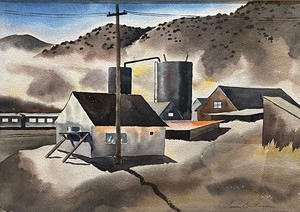
Samuel  Bolton Colburn - "Railway Station and Storage Tanks" - Watercolor - 15" x 21" - Signed lower right
<br>Double sided: Coastal Seascape
Samuel Bolton Colburn
"Railway Station and Storage Tanks"
c. 1937

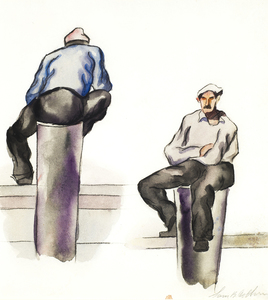
Samuel  Bolton Colburn - "Resting on the Pilings" - Watercolor - 12 1/2" x 11 1/2" - Signed lower right
Samuel Bolton Colburn
"Resting on the Pilings"
c.1941

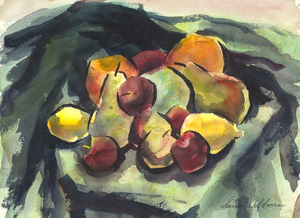
Samuel  Bolton Colburn - "Still Life with Fruit" - Watercolor - 14 1/4" x 20" - Signed lower right
<br>Double-sided: Houses and Cypress
<br>
<br>
<br>Reproduced in OLLI@CSUMB/Fall Catalogue-2022, BACK COVER
Samuel Bolton Colburn
"Still Life with Fruit"
c. 1942

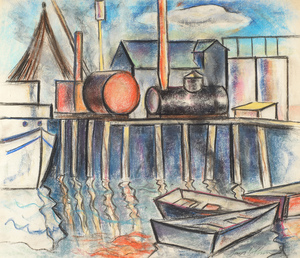
A quiet composition begins with rowboats docked by the pier in the foreground, a fishing boat docked near the pier on the left. The rest of the composition are the tanks used and a rooftop view of the canneries in the background.
Samuel Bolton Colburn
"Tanks at the Canneries"
c.1941

Samuel  Bolton Colburn - "Valley Farm Houses - Afternoon Light" - Watercolor - 15 1/2" x 22" - Signed and dated lower left
<br>Double-sided: Trees and Hills -1938
<br>Signed and dated lower right
Samuel Bolton Colburn
"Valley Farm Houses - Afternoon Light"
1938

A landscape scene beginning with a tree in the foreground, a winding road pasing houses, and a water tower taking you up to the final destination - a house on the hilltop.
Samuel Bolton Colburn
"Water Tower and Houses"
1942

Three fishermen dominate this scene - they are on the deck of a fishing boat and are working the nets in perfect harmony. Another fishing boat can be seen in the far distance.
Samuel Bolton Colburn
"Working the Nets"
1938

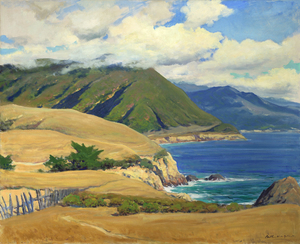
A coastal landscape with cypress trees in the foreground, the blue of the ocean on the right side and a view of Mount Doud dominates the background - with beautiful puffy clouds resting on the majestic mountain top.
Arthur Hill Gilbert, A.N.A.
"Mt. Doud, Big Sur"
c. 1928

Armin C. Hansen, N.A. - "Empire Builders" - Oil on board - 15 3/4" 19 3/4" - Signed lower left
<br>Titled and signed on reverse
<br>One of two paintings that Hansen exhibited
<br>at the CAA's 1936 Christmas Show.
<br>
<br>A symbolic creation inspired by California’s Gold Rush era in the days of the Forty Niners
<br>
<br>The "Empire Builders" is one of three significant paintings that Thelma B. Miller, art critic for the Carmel Pine Cone, singles out as a “new” method of painting which Armin Hansen briefly and very successfully ventured into in 1936.
<br>
<br>The following is excerpted from: Jennie V. Cannon: The Untold History of the Carmel and Berkeley Art Colonies, Volume 1, East Bay Heritage Project, by Robert W. Edwards/2012, page 429:
<br>
<br>In the summer of 1936, Hansen completed for the new library at Carmel's Sunset School his WPA Federal Art Project mural entitled 'The Span of Life', a symbolical creation in light, bright colors…'. That fall at the Carmel Art Association's Exhibition of Oils, Miller observed: The Hansen painting, 'With the Wind', seems to mark further the emergence of a new method by this outstanding artist. He has never made finer use of color than in some of his recent paintings. Of his two entries at the Carmel Art Association's Christmas Show in 1936 Miller found that one was a "blue-water" canvas in his "old method," but the other was executed in the new "symbolism which he is currently practicing" with "a whole new palette full of colors…his 'Empire Builders' inspired by the covered wagon period, but not historic or genre in style." 
<br>
<br>
<br>The following is excerpted from: Armin Hansen: The Artful Voyage by Scott A. Shields, PhD. / 2015:
<br>
<br>"For decades, the American frontier symbolized the youth and potential of the new nation, but with development bridging the coasts and the country connected by iron rails and roads, the need to civilize the American wilds was waning, and the idea of the frontier was quickly becoming self-conscious, a sure sign that the era had passed. And yet the frontier did linger symbolically, making images and stories of humanity's interactions with nature appealing." Page 29.
<br>
<br>CHRONOLOGY: December/1936: Exhibits two paintings (a blue marine and Empire Builders) in a show of small paintings at the Carmel Art Association. Page 251.
<br>
<br>NOTE: Hansen painted a larger version of 'Empire Builders' in 1949, oil on canvas, 24” x 36”, commemorating the year of the Gold Rush. It is in the permanent collection of the Monterey Museum of Art.
NEW
Armin C. Hansen, N.A.
"Empire Builders"
1936

Armin C. Hansen, N.A. - "Pine Trees" - Monterey - Conte Crayon on paper - 19 1/2" x 19 1/2" - Signed lower right
<br>
<br>"Before Hansen, when artists painted Monterey scenes with workers, they most often depicted them in connection with the historic Carmel Mission or quietly performing agricultural chores in peaceful harmony with the land, evincing the lingering influence of the French Barbizon style that Tavernier introduced in the mid-1870s. Such paintings were popular because they were soothing and restful, offering an oasis of tranquility and escape. These evolved into pure landscapes focusing on the beautiful coast, with attention accorded to the wind-sculpted Monterey cypress trees clinging to rocky shores. 
<br>
<br>Hansen, who saw himself as part of a new generation, painted pure landscapes infrequently and believed the indigenous and emblematic cypress to be overused. When he did depict the cypress or pine, he tended to organize the trees into abstractly patterned groups rather than depict them as single, arboreal curiosities, which by then had become ubiquitous on postcards and paintings made for tourists.”   
<br>
<br>Source: Armin Hansen: The Artful Voyage/2015, Scott A. Shields, PhD. Page 24.
Armin C. Hansen, N.A.
"Pine Trees" - Monterey
c. 1935

Maurice Logan, N.A. - "Early Morning -  Point Lobos" - Oil on canvas - 36" x 40" - Signed lower left
<br>
<br>The original paper label for this exhibition is on reverse:
<br>
<br>Exhibited: M.H. de Young Memorial Museum, San Francisco
<br>22nd Annual Exhibition of the Society of Western Artists/1962. Maxwell Galleries,(SF). Labels on reverse.
<br>
<br>In 1957 Maurice Logan had a solo show in the former Saint Mary's College Art Gallery. The Hearst Art Gallery presents this rediscovery of the entire career of this very important artist:
<br>
<br>Maurice Logan/Artist and Designer - A Retrospective of Paintings from the "Society of Six" years to the 1960s: Hearst Art Gallery-Saint Mary's College of California/1991. Number 81. in Exhibition Checklist, page 14.
NEW
Maurice Logan, N.A.
"Early Morning - Point Lobos"
c. 1939

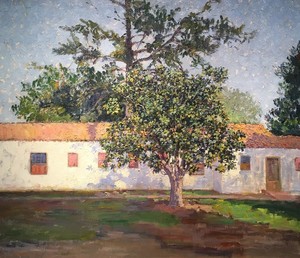
Evelyn McCormick - "Spanish Bungalow, Hotel Del Monte" - Oil on canvas - 26" x 30" - Authentication on reverse by artist/friend Myron A. Oliver
<br>
<br>The setting for this painting is on the grounds of the Hotel Del Monte depicting one of several individual cottages referred to as Spanish Bungalows. Artist, Francis McComas, was given residence in one such bungalow by his patron and close friend, S.F.B. Morse.
Evelyn McCormick
"Spanish Bungalow, Hotel Del Monte"
c. 1928

Thomas A. McGlynn - "Silhouette" - Oil on masonite - 16" x 20" - Estate signature lower left
<br>Titled, Estate Inventory #206 and signed on reverse
<br>by Thomas A McGlynn Jr.
<br>Directly from the estate of Thomas A. McGlynn
Thomas A. McGlynn
"Silhouette"

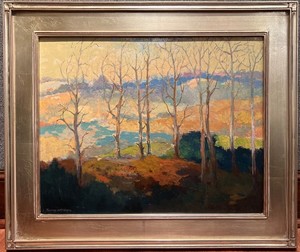
Thomas A. McGlynn - "Winter Light" - Oil on canvas - 34" x 36" - Signed lower right
<br>
<br>From the estate of Thomas A. McGlynn
<br>Estate Inv. #166 on reverse stretcher
Thomas A. McGlynn
"Winter Light"

Thomas A. McGlynn - "Wood Indigo" - Oil on board - 16" x 20" - Signed lower right
<br>Signed and titled on reverse
<br>Directly from the estate of Thomas A. McGlynn
<br>
<br>"Wood Indigo" is painted in a much more colorful palette closer to post impressionism and dates from the mid to latter 1930s. The technique incorporates both palette knife and brushwork - very skillfully rendered. There are a lot of nuances in color and texture that can only be appreciated in person.
Thomas A. McGlynn
"Wood Indigo"

S.F.B. Morse - "View towards Carmel Bay from Pebble Beach" - Watercolor - 17" x 22 1/2" sight size - Signed and dated lower right
S.F.B. Morse
"View towards Carmel Bay from Pebble Beach"
1944

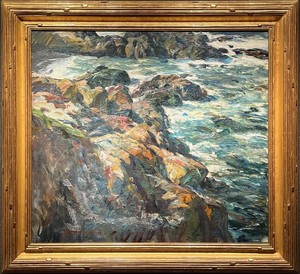
John O'Shea - "Seascape and Rocks,  Point Lobos" - Oil on canvas - 30" x 36" - Signed lower left
<br>
<br>
<br>"Seascape and Rocks - Point Lobos" is a forcefully executed canvas representing the best of his early work off the coast near Carmel.   O'Shea employs loaded brushwork, deep saturated colors, and bold rhythmic patterns to create a work reminiscent of the powerful canvases of his peers - George Bellows, Armin Hansen and William Ritschel. 
<br>
<br>This painting is a rare early work by O'Shea, one of Carmel's most distinguished artists. With its view of Point Lobos, and of exhibition size, it is the finest O’Shea we have owned and one of the best he has ever painted of the California coast.
<br>
<br>O'Shea was born in Ireland - emigrated to the US in the 1890's (NYC). He first moved to Pasadena in 1913; Laguna Beach in 1915; and in 1917 he settled in the Carmel Highlands one cove north of William Ritschel's  ‘Castel a Mare’.
John O'Shea
"Seascape and Rocks, Point Lobos"
c. 1921

Carl Sammons - "PG Municipal Golf Course Holes 5-6" - Oil on canvasboard - 12" x 16" - Signed lower right
<br>Titled on reverse
<br>
<br>The Pacific Grove Municipal Golf Course, the Peninsula's only municipal golf course, is often called the "poor man's Pebble Beach." It is a public 18-hole golf course owned by the city of Pacific Grove, California.
<br>
<br>Originally designed by Chandler Egan in 1932, the first nine holes are laid out through the forested areas of Pacific Grove. The back nine was designed by Jack Neville, original designer of the Pebble Beach Golf Links in Pebble Beach, California, and overlook Point Pinos, where the Pacific Ocean and Monterey Bay meet on the northern tip of the Monterey Peninsula. The golf links is also site of the Point Pinos Lighthouse.
Carl Sammons
"PG Municipal Golf Course Holes 5-6"

Karl Schmidt - "Cabin at Dusk" - California - Oil on board - 30" x 72" - Signed and dated lower left
<br>Artist signed on reverse
<br>Artist's hand-carved arts & crafts frame with name plaque
<br>
<br>Partial Maxwell Galleries label on reverse
<br>
<br>Karl Schmidt was a leading proponent of the Arts and Crafts movement. Traveling to England from his native city in Worcester, MA he likely came under the influence of the arts and crafts painter Frank Brangwyn; and later the teachings of Arthur Wesley Dow. 
<br>
<br>In 1915 he moved to Santa Barbara joining a group of painters in the mission-style studio of California artist, Alexander Harmer. His paintings were displayed at the Panama Pacific International Exposition in San Francisco (PPIE), 1915. He further exhibited at the Los Angeles County Museum of Art (LACMA), the Art Institute of Chicago, National Academy of Design, and the Cincinnati Museum of Art, among many other venues.
Karl Schmidt
"Cabin at Dusk" - California
1919

Catherine Comstock Seideneck - "Fishing Boats at Rest" - Oil on canvas - 36" x 42" - Signed lower right
Catherine Comstock Seideneck
"Fishing Boats at Rest"
c.1927

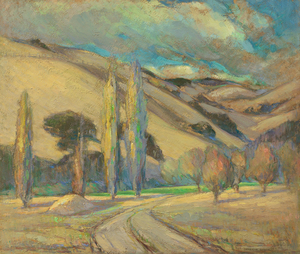
Catherine Comstock Seideneck - "Road through the Orchards" - Oil/masonite - 27 1/2" x 32 1/2" - Signed lower right
<br>
<br>~An accomplished artisan and teacher ~
<br>Equally skilled as a painter of oil, watercolor, pastel, and oil wash
Catherine Comstock Seideneck
"Road through the Orchards"
c.1935

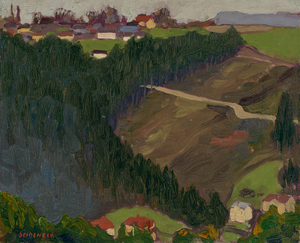
George Joseph Seideneck - "Bad Schandau on the Elbe" - Oil on canvas - 25" x 30" - Signed lower left
<br>
<br>~An accomplished artisan and teacher ~
<br>Won recognition as a portraiture, photographer and landscape painter
<br>
<br>As a youth, he had a natural talent for art and excelled in drawing boats on Lake Michigan. Upon graduation from high school, he briefly became an apprentice to a wood engraver. He received his early art training in Chicago at the Smith Art Academy and then worked as a fashion illustrator. He attended night classes at the Chicago Art Institute and the Palette & Chisel Club. 
<br>
<br>In 1911 Seideneck spent three years studying and painting in Europe. When he returned to Chicago he taught composition, life classes and portraiture at the Academy of Fine Art and Academy of Design.
<br>
<br>He made his first visit to the West Coast in 1915 to attend the P.P.I.E. (SF).  Seideneck again came to California in 1918 on a sketching tour renting the temporarily vacant Carmel Highlands home of William Ritschel. While in Carmel he met artist Catherine Comstock, also a Chicago-born Art Institute-trained painter. They married in 1920 and made Carmel their home, establishing studios in the Seven Arts Building and becoming prominent members of the local arts community.
George Joseph Seideneck
"Bad Schandau on the Elbe"
c.1925

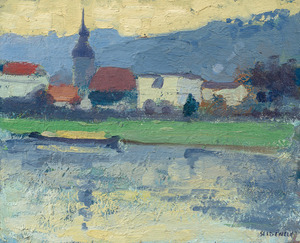
George Joseph Seideneck - "Bad Schandau on the River Elbe" - Oil on canvas/board - 10 1/2" x 13" - Estate signed lower right
<br>PROVENANCE: From the estate of:
<br>GEORGE J. SEIDENECK
<br>Carmel Valley, Dec. 1, 1972
<br>Arne Halle – Trustee
<br>
<br>~An accomplished artisan and teacher ~
<br>Won recognition as a portraiture, photographer and landscape painter
<br>
<br>As a youth, he had a natural talent for art and excelled in drawing boats on Lake Michigan. Upon graduation from high school, he briefly became an apprentice to a wood engraver. He received his early art training in Chicago at the Smith Art Academy and then worked as a fashion illustrator. He attended night classes at the Chicago Art Institute and the Palette & Chisel Club. 
<br>
<br>In 1911 Seideneck spent three years studying and painting in Europe. When he returned to Chicago he taught composition, life classes and portraiture at the Academy of Fine Art and Academy of Design.
<br>
<br>He made his first visit to the West Coast in 1915 to attend the P.P.I.E. (SF).  Seideneck again came to California in 1918 on a sketching tour renting the temporarily vacant Carmel Highlands home of William Ritschel. While in Carmel he met artist Catherine Comstock, also a Chicago-born Art Institute-trained painter. They married in 1920 and made Carmel their home, establishing studios in the Seven Arts Building and becoming prominent members of the local arts community.
George Joseph Seideneck
"Bad Schandau on the River Elbe"
c.1925

George Joseph Seideneck - "Cargo Boat - Venice, Italy" - Oil on canvas - 13" x 10" - Signed lower right
<br>
<br>~An accomplished artisan and teacher ~
<br>Won recognition as a portraiture, photographer and landscape painter
<br>
<br>As a youth, he had a natural talent for art and excelled in drawing boats on Lake Michigan. Upon graduation from high school, he briefly became an apprentice to a wood engraver. He received his early art training in Chicago at the Smith Art Academy and then worked as a fashion illustrator. He attended night classes at the Chicago Art Institute and the Palette & Chisel Club. 
<br>
<br>In 1911 Seideneck spent three years studying and painting in Europe. When he returned to Chicago he taught composition, life classes and portraiture at the Academy of Fine Art and Academy of Design.
<br>
<br>He made his first visit to the West Coast in 1915 to attend the P.P.I.E. (SF).  Seideneck again came to California in 1918 on a sketching tour renting the temporarily vacant Carmel Highlands home of William Ritschel. While in Carmel he met artist Catherine Comstock, also a Chicago-born Art Institute-trained painter. They married in 1920 and made Carmel their home, establishing studios in the Seven Arts Building and becoming prominent members of the local arts community.
George Joseph Seideneck
"Cargo Boat - Venice, Italy"

George Joseph Seideneck - "Gypsy Woman" - Oil on canvas - 12 3/4" x 9 1/2" - Signed lower right
<br>Illustrated: Carmel Art Association/Ninety Years, page 47
<br>
<br>~An accomplished artisan and teacher ~
<br>Won recognition as a portraiture, photographer and landscape painter
<br>
<br>As a youth, he had a natural talent for art and excelled in drawing boats on Lake Michigan. Upon graduation from high school, he briefly became an apprentice to a wood engraver. He received his early art training in Chicago at the Smith Art Academy and then worked as a fashion illustrator. He attended night classes at the Chicago Art Institute and the Palette & Chisel Club. 
<br>
<br>In 1911 Seideneck spent three years studying and painting in Europe. In England he studied with the Canadian painter, Harry Britton, under whom he developed a penchant for portraiture. When he returned to Chicago he taught composition, life classes and portraiture at the Academy of Fine Art and Academy of Design.
<br>
<br>He made his first visit to the West Coast in 1915 to attend the P.P.I.E. (SF).  Seideneck again came to California in 1918 on a sketching tour renting the temporarily vacant Carmel Highlands home of William Ritschel. While in Carmel he met artist Catherine Comstock, also a Chicago-born Art Institute-trained painter. They married in 1920 and made Carmel their home, establishing studios in the Seven Arts Building and becoming prominent members of the local arts community.
George Joseph Seideneck
"Gypsy Woman"

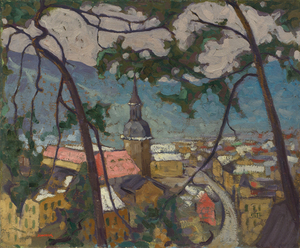
George Joseph Seideneck - "Landscape with Houses and Hills" - Oil on canvas/board - 10 1/2" x 13" - Estate signed lower left
<br>PROVENANCE: From the estate of:
<br>GEORGE J. SEIDENECK
<br>Carmel Valley, Dec. 1, 1972
<br>Arne Halle – Trustee
<br>
<br>
<br>~An accomplished artisan and teacher ~
<br>Won recognition as a portraiture, photographer and landscape painter
<br>
<br>As a youth, he had a natural talent for art and excelled in drawing boats on Lake Michigan. Upon graduation from high school, he briefly became an apprentice to a wood engraver. He received his early art training in Chicago at the Smith Art Academy and then worked as a fashion illustrator. He attended night classes at the Chicago Art Institute and the Palette & Chisel Club. 
<br>
<br>In 1911 Seideneck spent three years studying and painting in Europe. When he returned to Chicago he taught composition, life classes and portraiture at the Academy of Fine Art and Academy of Design.
<br>
<br>He made his first visit to the West Coast in 1915 to attend the P.P.I.E. (SF).  Seideneck again came to California in 1918 on a sketching tour renting the temporarily vacant Carmel Highlands home of William Ritschel. While in Carmel he met artist Catherine Comstock, also a Chicago-born Art Institute-trained painter. They married in 1920 and made Carmel their home, establishing studios in the Seven Arts Building and becoming prominent members of the local arts community.
George Joseph Seideneck
"Landscape with Houses and Hills"

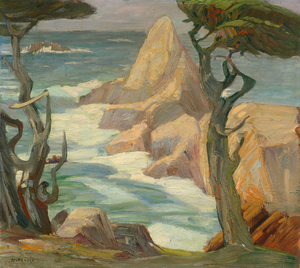
George Joseph Seideneck - "Pinnacle Rock" Pt. Lobos - Oil on board - 18" x 20" - Estate signed lower left
<br>PROVENANCE: From the estate of:
<br>GEORGE J. SEIDENECK
<br>Carmel Valley, Dec. 1, 1972
<br>Arne Halle – Trustee
<br>
<br>
<br>~An accomplished artisan and teacher ~
<br>Won recognition as a portraiture, photographer and landscape painter
<br>
<br>As a youth, he had a natural talent for art and excelled in drawing boats on Lake Michigan. Upon graduation from high school, he briefly became an apprentice to a wood engraver. He received his early art training in Chicago at the Smith Art Academy and then worked as a fashion illustrator. He attended night classes at the Chicago Art Institute and the Palette & Chisel Club. 
<br>
<br>In 1911 Seideneck spent three years studying and painting in Europe. When he returned to Chicago he taught composition, life classes and portraiture at the Academy of Fine Art and Academy of Design.
<br>
<br>He made his first visit to the West Coast in 1915 to attend the P.P.I.E. (SF).  Seideneck again came to California in 1918 on a sketching tour renting the temporarily vacant Carmel Highlands home of William Ritschel. While in Carmel he met artist Catherine Comstock, also a Chicago-born Art Institute-trained painter. They married in 1920 and made Carmel their home, establishing studios in the Seven Arts Building and becoming prominent members of the local arts community.
George Joseph Seideneck
"Pinnacle Rock" Pt. Lobos

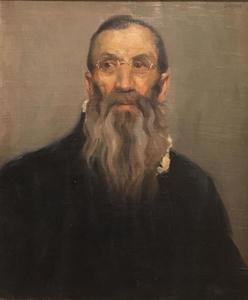
George Joseph Seideneck - "The Old Philosopher" - Oil on canvas - 24" x 20" - Signed upper right
<br>Signed and dated lower right
<br>
<br>Exhibited:  Carmel Art Association's Members Exhibition at the Stanford Art Gallery in 1929. “The Old Philosopher” was chosen as one of the thirty-five best paintings for inclusion in a traveling exhibition with stops at the Oakland Art Gallery and the East-West Gallery. At the latter, this painting was admired for its "conservative character." 
<br>
<br>Seideneck also exhibited “The Old Philosopher” in 1932 at the Carmel Art Association’s Sixteenth Exhibition.
<br>
<br>
<br>~An accomplished artisan and teacher ~
<br>Won recognition as a portraiture, photographer and landscape painter
<br>
<br>As a youth, he had a natural talent for art and excelled in drawing boats on Lake Michigan. Upon graduation from high school, he briefly became an apprentice to a wood engraver. He received his early art training in Chicago at the Smith Art Academy and then worked as a fashion illustrator. He attended night classes at the Chicago Art Institute and the Palette & Chisel Club. 
<br>
<br>In 1911 Seideneck spent three years studying and painting in Europe. In England he studied with the Canadian painter, Harry Britton, under whom he developed a penchant for portraiture. When he returned to Chicago he taught composition, life classes and portraiture at the Academy of Fine Art and Academy of Design.
<br>
<br>He made his first visit to the West Coast in 1915 to attend the P.P.I.E. (SF).  Seideneck again came to California in 1918 on a sketching tour renting the temporarily vacant Carmel Highlands home of William Ritschel. While in Carmel he met artist Catherine Comstock, also a Chicago-born Art Institute-trained painter. They married in 1920 and made Carmel their home, establishing studios in the Seven Arts Building and becoming prominent members of the local arts community.
George Joseph Seideneck
"The Old Philosopher"
1913

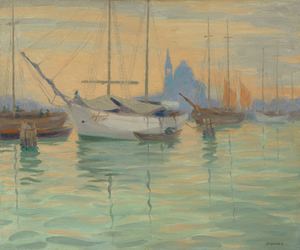
George Joseph Seideneck - "Venetian Boats" - Oil on canvas - 20" x 24" - Signed lower right
<br>Signed and titled on reverse
<br>
<br>
<br>~An accomplished artisan and teacher ~
<br>Won recognition as a portraiture, photographer and landscape painter
<br>
<br>As a youth, he had a natural talent for art and excelled in drawing boats on Lake Michigan. Upon graduation from high school, he briefly became an apprentice to a wood engraver. He received his early art training in Chicago at the Smith Art Academy and then worked as a fashion illustrator. He attended night classes at the Chicago Art Institute and the Palette & Chisel Club. 
<br>
<br>In 1911 Seideneck spent three years studying and painting in Europe. When he returned to Chicago he taught composition, life classes and portraiture at the Academy of Fine Art and Academy of Design.
<br>
<br>He made his first visit to the West Coast in 1915 to attend the P.P.I.E. (SF).  Seideneck again came to California in 1918 on a sketching tour renting the temporarily vacant Carmel Highlands home of William Ritschel. While in Carmel he met artist Catherine Comstock, also a Chicago-born Art Institute-trained painter. They married in 1920 and made Carmel their home, establishing studios in the Seven Arts Building and becoming prominent members of the local arts community.
George Joseph Seideneck
"Venetian Boats"

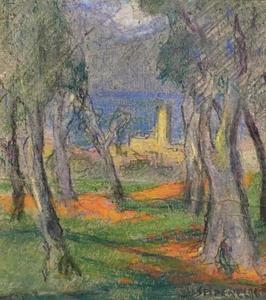
George Joseph Seideneck - Pastel study for Village Castle on - Pastel - 6" x 5 1/2" - Estate signed lower right
<br>PROVENANCE: From the estate of:
<br>GEORGE J. SEIDENECK
<br>Carmel Valley, Dec. 1, 1972
<br>Arne Halle – Trustee
<br>
<br>
<br>~An accomplished artisan and teacher ~
<br>Won recognition as a portraiture, photographer and landscape painter
<br>
<br>As a youth, he had a natural talent for art and excelled in drawing boats on Lake Michigan. Upon graduation from high school, he briefly became an apprentice to a wood engraver. He received his early art training in Chicago at the Smith Art Academy and then worked as a fashion illustrator. He attended night classes at the Chicago Art Institute and the Palette & Chisel Club. 
<br>
<br>In 1911 Seideneck spent three years studying and painting in Europe. When he returned to Chicago he taught composition, life classes and portraiture at the Academy of Fine Art and Academy of Design.
<br>
<br>He made his first visit to the West Coast in 1915 to attend the P.P.I.E. (SF).  Seideneck again came to California in 1918 on a sketching tour renting the temporarily vacant Carmel Highlands home of William Ritschel. While in Carmel he met artist Catherine Comstock, also a Chicago-born Art Institute-trained painter. They married in 1920 and made Carmel their home, establishing studios in the Seven Arts Building and becoming prominent members of the local arts community.
George Joseph Seideneck
Pastel study for Village Castle on

Gunnar Widforss - "Bright Angel Trail" - Watercolor - 16" x 20" - Notarized estate provenance on reverse
<br>With title plaque
<br>
<br>This work is recorded and illustrated in the online catalogue raisonné of Gunnar Widforss’ work by Alan Petersen as catalogue entry #420. The online catalogue raisonné is available at www.gunnarwidforss.com.
<br>
<br>"Although it isn't one of his "classic" Canyon paintings it is a great document of his practice of hiking in the Canyon to paint in remote locations." (excerpted from email from Alan Petersen/05/04/2022).
<br>
<br>"Gunnar painted it near the mouth of Bright Angel Canyon, about a mile from Phantom Ranch, near the Colorado River, looking downstream. He probably would have been near the trail, but not really on it. In the painting, the river is hidden by the diagonal slope that cuts across the view from the right (north). The Bright Angel Trail itself is just out of the view to the right, further downstream." 
<br>
<br>"Since the painting has been known by that title (Bright Angel Trail) for some time, I think I'd stick with it. It maybe isn't the most accurate, geographically, but it's also not inaccurate. I'm going to change the title in the catalogue. (Grand Canyon: Inner Canyon).
<br>
<br>(excerpted from email from Alan Petersen/06/03/2022).
NEW
Gunnar Widforss
"Bright Angel Trail"
c. 1930

Sydney Yard - "Marshland near Monterey" - Watercolor - 10" x 14 1/2" - Signed lower right
<br>
<br>“A painter of California, one of the very few native-born, we have in Sydney Yard, who, from an early meticulous manner, developed a broader and decorative delineation of the northern California landscape. His medium was watercolor, and his sincerely studied and finely patterned small canvases are distributed through many California homes. His work is charming without being weak.” (The History & Ideals of American Art by Eugen Neuhaus, 1931).
<br>
<br>A pioneer Carmel artist, Sydney Yard established one of the first studios on Lincoln and Seventh Streets.
<br>
<br>Born 1855 in Rockford, Illinois, Yard began his art studies under George J. Robertson. He later studied in the British Isles where he mastered English watercolor techniques under the instruction of Royal Academician Sutton Palmer.
<br>
<br>In 1882, after achieving some recognition in New York, Yard moved to California. For the first three years he ran several photography studios in San Jose and Palo Alto with artist friend Andrew Putnam Hill. During this time, he exhibited several paintings at the San Francisco Art Association.
<br>
<br>Yard settled permanently in Carmel in 1906. He exhibited frequently at The Del Monte Gallery as well as at several galleries in the San Francisco Bay Area until his death in 1909. Best known for his watercolors, his works are primarily landscapes and coastal scenes of the Monterey Peninsula.
Sydney Yard
"Marshland near Monterey"

  • Exhibitions
  • Inventory
  • New Acquisitions
  • Sell Your Art
  • Sold Inventory
Please visit us at our following locations:

Carmel
On San Carlos near 7th
Paseo San Carlos Court

ph 831.625.3246
cell 831.238.4632
Tues - Sat 11 - 4:00
Open Sun and Mon by appointment or chance


Pacific Grove
301-303 Forest Avenue
Across from City Hall

ph 831.649.3246
cell 831.238.4631
Open Tue - Sat 12 - 4:00
And by appointment or chance


Mailing
P.O. Box 3246
Carmel, CA
93921

FADA

FADA

gallery powered by
© Copyright 2026 Trotter Galleries, Inc. All Rights Reserved.
error: Content is protected !!